
Good rowing performance requires more than great technique. Understanding injury, developing strength and getting nutrition right are essential for athletes at every level.
At Star Physio, we’ve been helping rowers perform at their best for almost 30 years, from school beginners through to Australian national champions.
Recently, Star Physio Principal Physiotherapist Damian Oldmeadow spent time on the Swan River with the UWA Rowing Head Coach, observing and discussing technique, performance and injury management across a number of UWA athletes.
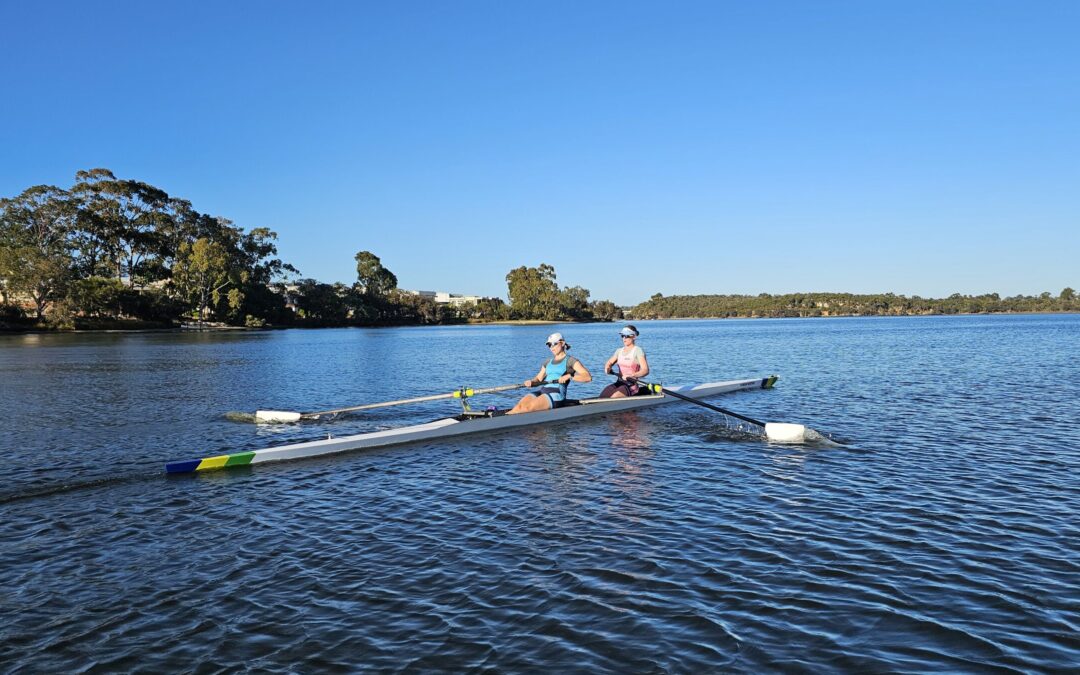
Among those training were the Australian Under 21 Women’s Pair champions, providing a fantastic opportunity to observe some of Australia’s best young rowing talent in action.
Watching elite rowers is a reminder of the importance of efficient technique. However, when it comes to injury management, the relationship between technique, pain and performance is more complicated than many people realise.
Australian Under 21 Women’s Pair champions training on the Swan River. Star Physio works alongside athletes and coaches to support rowing performance and injury management.
Does Poor Rowing Technique Cause Injuries?
Traditionally, rowing injuries, particularly lower back pain, have frequently been blamed on poor technique.
However, research suggests that rowing technique alone is not a reliable predictor of who will develop an injury.
There is considerable variation in how athletes move, even among elite rowers. There is no single perfect rowing technique that guarantees an athlete will remain injury-free.
Research has identified several important factors associated with rowing-related lower back pain, including:
- Previous episodes of back pain or injury.
- Rapid increases in training load.
- High training volumes and prolonged ergometer sessions.
- Fatigue and inadequate recovery.
A 2025 systematic review and meta-analysis found that rowers with a history of lower back pain had approximately 2.65 times the odds of experiencing back pain compared with those without a previous history.
This doesn’t mean technique is unimportant. Efficient technique is fundamental to performance, and movement patterns can influence how forces are distributed through the body.
However, identifying an unusual movement pattern doesn’t necessarily explain why an athlete is experiencing pain.
Could Injury Actually Be Changing Your Technique?
An important consideration when assessing an injured rower is whether their technique is contributing to their symptoms, or whether their symptoms are changing their technique.
Pain and previous injury can alter movement patterns, muscle activation and an athlete’s willingness to load particular parts of their body.
For example, a rower experiencing back pain may unconsciously change their movement through the catch or drive phase to avoid discomfort.
These adaptations may initially be protective, but can sometimes persist and contribute to ongoing symptoms or reduced performance.
Rather than simply correcting a perceived technical fault, we need to understand the underlying injury, training demands and physical capacity of the athlete.
This is where collaboration between physiotherapists, coaches and rowers becomes particularly valuable.
Good physiotherapy should complement good coaching, not replace it.
Working Together to Understand Rowing Injuries
At Star Physio, we regularly collaborate with rowing coaches to assess athletes experiencing persistent pain or injury.
Recently, we worked with a UWA rower using an indoor rowing ergometer in our Star Physio gym, alongside two UWA rowing coaches.
This collaborative approach allows us to combine the coaches’ detailed understanding of rowing technique with our clinical assessment of injury, strength, mobility and physical capacity.
Importantly, the goal isn’t simply to identify and correct a perceived technical fault. It’s to understand whether pain or physical limitations are influencing the athlete’s movement and how we can help them return to comfortable, effective rowing.
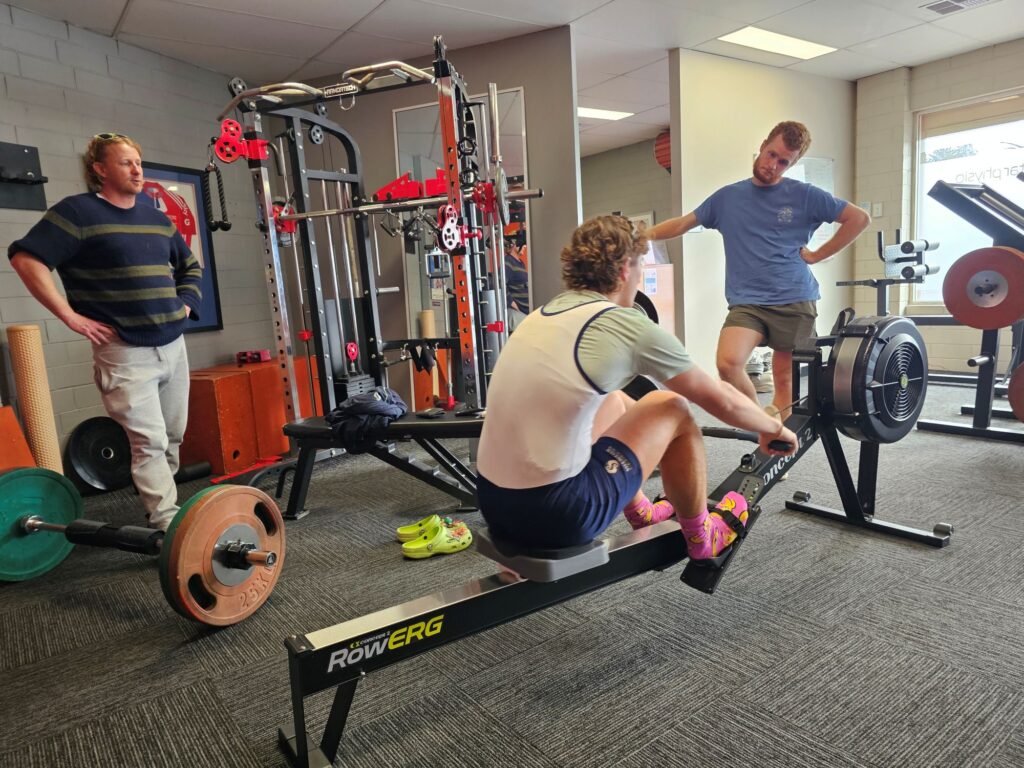
Star Physio working alongside UWA rowing coaches to assess rowing technique and movement patterns.
Learn more about our Rowing Physiotherapy and Injury Management Services in Perth.
Strength and Conditioning: One of Our Best Tools for Rowers
While technique is important for performance, developing adequate strength and physical capacity is essential for helping athletes tolerate the demands of training and competition.
Strength training is one of our most valuable tools for improving sporting performance and building resilience against injury.
Research across multiple sports demonstrates that appropriately designed strength training programs can significantly reduce sporting injury rates. Although rowing-specific injury prevention evidence is more limited, the benefits of strength training for developing force production and supporting rowing performance are well established.
A good rowing strength program can help:
- Develop lower limb strength and power.
- Improve trunk strength and endurance.
- Increase tolerance to repeated training loads.
- Address strength deficits following injury.
- Improve force production and rowing performance.
Is Strength Training Safe for Young Rowers?
Absolutely! Appropriately designed and supervised strength training is safe and effective for athletes of all ages and abilities.
Despite decades of research supporting youth resistance training, some parents and young athletes remain concerned that lifting weights might damage growing bodies or interfere with growth.
These concerns are not supported by current scientific evidence when training is appropriately prescribed and supervised.
In fact, strength training offers significant benefits for children and adolescents, including improved strength, coordination, bone health, physical confidence and sporting performance.
There is no evidence that properly supervised resistance training stunts growth.
For younger athletes, training might initially involve bodyweight exercises, resistance bands and learning fundamental movement patterns. External resistance can then be progressively introduced as strength, skill and confidence develop.
There is no need to wait until an athlete has finished growing before starting strength training.
Whether you’re a 13-year-old beginning school rowing, a university athlete competing nationally or a masters rower, an appropriately designed program can help.
And as we like to say at Star Physio:
“The best time to start strength and conditioning was yesterday. The next best time is today!”
For many rowers, one or two structured strength sessions per week can provide an excellent foundation, depending on their experience, training load and recovery.
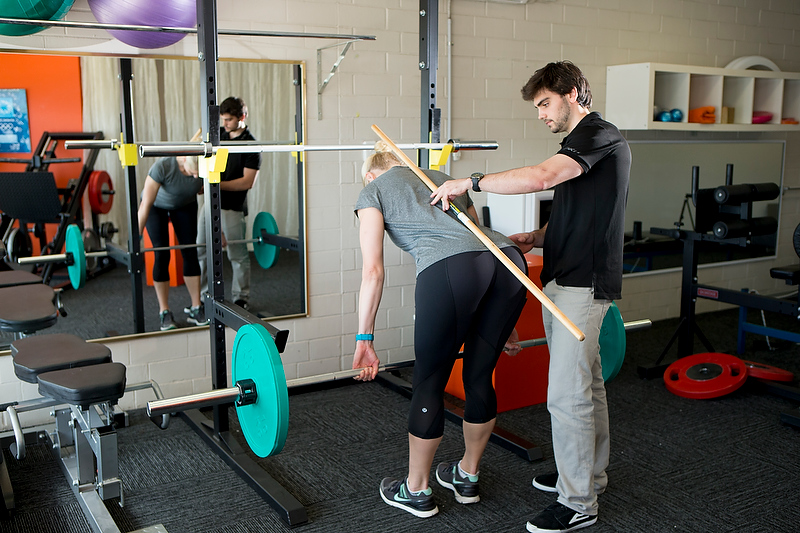
Star Physio physiotherapist Steve Jeffries coaching a rower through correct deadlift technique to develop strength, confidence and physical resilience.
Nutrition: Fuel Your Training, Recovery and Performance
Strength training and rehabilitation are important, but athletes also need to fuel their bodies properly to recover, adapt and perform.
Good nutrition is critical for sporting performance, recovery and reducing injury risk.
Rowing places significant demands on the body, particularly for young athletes balancing early morning training, school, gym sessions and competition.
Inadequate energy intake can contribute to fatigue, poor recovery, reduced performance and increased risk of illness and injury, including bone stress injuries.
This is particularly important for adolescent athletes who need sufficient energy to support both training and normal growth.
Star Physio’s Accredited Sports Dietitian Donna Kimpton recently presented to almost 100 athletes, coaches and families at the UWA/Shenton Rowing Club Development Dinner, discussing the importance of fuelling for rowing performance.
Donna has also developed practical nutrition resources for rowers, covering carbohydrate intake, recovery nutrition and matching food intake to training demands.
Read Donna’s article and access her free rowing nutrition resources:
Fuelling Rowing Performance – Sports Dietitian Donna Kimpton
School Holidays: The Perfect Time to Get Stronger!
With the summer school holidays approaching, now is an ideal opportunity for school-aged rowers to address lingering injuries and prepare for the next rowing season.
At Star Physio, we encourage young rowers to focus on three priorities.
1. Get Those Niggles Under Control
Persistent back, rib, knee or shoulder pain shouldn’t simply be accepted as part of rowing.
An accurate diagnosis and appropriate rehabilitation program can help athletes manage symptoms and return to training with confidence.
2. Start or Improve Your Strength Program
Whether you’re new to the gym or already training regularly, a structured strength program can make a significant difference.
The holidays provide an excellent opportunity to develop good lifting technique, address strength limitations and progressively build physical capacity.
3. Prepare for the Next Rowing Season
Building strength takes time.
Starting during the holidays allows rowers to develop strength and resilience before the demands of school rowing and competition increase.
Rowing Physiotherapy at Star Physio – From Beginners to National Champions
Star Physio has a longstanding association with rowing in Western Australia.
Principal Physiotherapist Damian Oldmeadow began working with elite rowing athletes at the Australian Institute of Sport in 1997.
Since then, our team has supported school rowing programs, UWA and Shenton College athletes, WA pathways squads and rowers competing at Australian National Championships.
Our approach combines accurate diagnosis, evidence-based injury management, strength and conditioning, nutrition advice and collaboration with coaches.
With fully equipped rehabilitation gyms at our West Perth and Mosman Park clinics, we help rowers progress from injury management through to strength development and sporting performance.
Whether you’re preparing for your first school rowing season or competing for national titles, Star Physio can help you stay healthy, get stronger and perform at your best.
Ready to Prepare for Your Next Rowing Season?
Make the most of the upcoming school holidays.
Star Physio – West Perth & Mosman Park
Phone: 08 6424 9578
References
- Wilson F, Gissane C, McGregor A. (2014). Ergometer training volume and previous injury predict back pain in rowing; strategies for injury prevention and rehabilitation. British Journal of Sports Medicine.
https://doi.org/10.1136/bjsports-2014-093968 - Wilson F, et al. (2021). 2021 consensus statement for preventing and managing low back pain in elite and subelite adult rowers. British Journal of Sports Medicine, 55, 893–899.
https://doi.org/10.1136/bjsports-2020-103385 - Risk factors associated with low back pain in rowers: A systematic review and meta-analysis. (2025). BMC Sports Science, Medicine and Rehabilitation.
https://doi.org/10.1186/s13102-025-01153-y - Faigenbaum AD, et al. (2009). Youth resistance training: Updated position statement paper from the National Strength and Conditioning Association. Journal of Strength and Conditioning Research, 23(5 Suppl), S60–S79.
- Mountjoy M, et al. (2023). 2023 International Olympic Committee’s consensus statement on Relative Energy Deficiency in Sport (REDs). British Journal of Sports Medicine, 57, 1073–1098.
https://bjsm.bmj.com/content/57/17/1073
