
Why Being Strong Isn’t Enough: The Missing Link in Rehab and Performance
Written by Amy Ross, Physiotherapist & Exercise Scientist at Star Physio WA, with a clinical focus on strength, rehabilitation and return to sport performance.
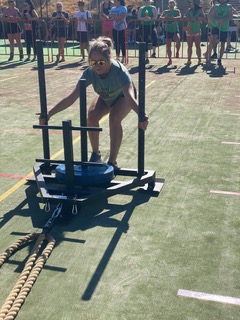
Amy Ross during Crossfit competition
Is Being Strong Enough in Rehabilitation?
No — being strong alone is not enough in rehabilitation. To safely return to sport and reduce injury risk, you also need to restore rate of force development (RFD), which is your ability to produce force quickly under real-world demands. At Star Physio, our rehabilitation and sports physiotherapy programs integrate both strength and explosive intent to ensure you’re not just strong, but prepared for the speed of sport and life.
Most athletes and active individuals now understand that strength training is essential. Lifting weights is no longer reserved for power athletes — and for good reason.
Strength training helps:
- reduce injury risk
- improve performance
- enhance movement efficiency
Even if you do not consider yourself an athlete, strength still plays a critical role in everyday movement, joint protection and long-term health.
But this is where the conversation often stops too early.
Because in both rehabilitation and performance, being strong is only part of the equation.
The real question is: how quickly can you use that strength?
Strength Is Not Just One Thing
Strength can be broken down into different qualities:
- Maximal strength → the highest force you can produce
- Explosive strength (Rate of Force Development – RFD) → how quickly you can produce that force
That second quality is often the missing link in both rehab and performance.
Why Rate of Force Development (RFD) Matters
In real-world movement, you do not have unlimited time to produce force.
Most sporting actions happen fast:
- sprinting
- jumping
- cutting and changing direction
- reacting to instability
These movements often occur in less than 200 milliseconds.
Why This Matters for Cyclists and Runners
At Star Physio, we work extensively with cyclists and runners — and this is where RFD becomes highly relevant.
For cyclists
- sprinting out of corners
- attacking on climbs
- accelerating in a bunch
- transitioning from seated to standing
These all require rapid force production, not just strength. Even a strong rider can feel “flat” if they cannot access that strength quickly.
For runners
Every step requires fast force production.
- ground contact times are short
- muscles must stabilise and produce force rapidly
- efficient force transfer improves running economy
For example, the glute medius must activate quickly to control pelvic stability. Delayed force leads to inefficiency, overload and increased injury risk.
Why This Matters for Volleyball Players

Star Physio working with Australian Women’s Volleyball Team
For volleyball athletes, rate of force development is directly linked to jump height, blocking ability and spiking power. Movements such as jumping for a spike or reacting quickly at the net occur in very short timeframes, meaning there is limited opportunity to express maximal strength.
Athletes who can produce force more rapidly will generate greater vertical height and more powerful movements on court. This also plays a key role in injury prevention, particularly with repeated jumping and landing demands. At Star Physio, we incorporate both strength and explosive training into rehabilitation and performance programs to help volleyball players improve power, reduce injury risk and return to play with confidence.
With Star Physio’s long-standing involvement in volleyball at state and national levels, this approach is central to how we prepare athletes for performance and return to play.
Why This Matters in Injury Prevention
When your foot hits the ground, your body has a very small window to:
- stabilise joints
- absorb load
- protect tissues
Muscles must respond in as little as 30–70 milliseconds.
If that response is too slow, ligaments and passive structures take more load.
This is where Rate of Force Acceptance (RFA) becomes critical — your ability to absorb and control force quickly.
In many sporting tasks, landing forces can reach 3.5–7.1 times bodyweight within the first 30 milliseconds of ground contact.
How Do We Measure It?
In ideal settings, RFD is measured using:
- force plates
- dynamometry
- isometric strength testing
In the clinic, we often assess it through:
- jump testing
- hop testing
- repeated rebound tasks
- rapid step-ups
- sprint and change-of-direction drills
At Star Physio, we combine clinical testing with tools such as force measurement systems to assess both maximal strength and RFD, helping guide rehabilitation and return to sport decisions.
The Rehab Gap: Strength vs Speed
A common issue we see clinically is:
- strength improves
- speed of force production does not
Even years after ACL reconstruction:
- strength may recover
- but RFD deficits can persist by 20–23%
Maximal strength takes more than 250 milliseconds to develop, yet most injury scenarios occur much faster.
This is why simply being “strong enough” often is not enough.
How This Applies to Return to Sport
At Star Physio, our approach to return to sport rehabilitation goes beyond strength alone.
We specifically target:
- fast force production
- rapid force absorption
- reactive control
Our sports physiotherapy and return to sport rehabilitation programs focus on restoring both strength and speed to reduce reinjury risk and improve performance outcomes.
Beyond Sport: Why It Matters for Everyone
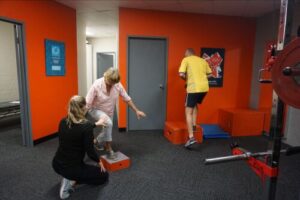
Rehabilitation Class at Star Physio
As we age, we lose:
- strength
- and the ability to produce it quickly
This impacts:
- balance
- fall prevention
- independence
Many real-world tasks — such as catching a trip or recovering balance — rely on fast strength, not slow strength.
Do We Still Need Heavy Strength Training?
Yes.
Maximal strength remains the foundation.
- Strength = size of the engine
- RFD = how quickly you can use it
If your strength base is low, your potential is limited. But if you cannot access that strength quickly, it will not transfer effectively.
The Real Answer
It is not strength or speed.
It is strength plus speed, trained together.
How to Train Rate of Force Development
The key concept is intent.
You must move with speed and purpose:
- drive the bar up fast
- jump with maximal effort
- perform step-ups explosively
Practical Ways to Add It In
1. Build the Strength Base
- squats
- deadlifts
- split squats
- lunges
- hip thrusts
2. Move Lighter Loads Fast
- jump squats
- trap bar jumps
- medicine ball throws
3. Use Bodyweight Power Work
- jumps
- hops
- bounds
- explosive step-ups
4. Add Plyometrics
- landing and rebounding drills
5. Progress to Reactive Work
- repeated hops
- change-of-direction drills
When Should You Train It?
- early in the session
- when fresh
- prioritise quality
If performance drops, stop the set.
How Much Do You Need?
- low volume
- high quality
- consistent exposure
Who Benefits Most?
- runners
- cyclists
- field and court athletes
- post-injury athletes
- older adults
In reality, almost everyone.
Final Takeaway
Being strong matters.
But strength is only useful if you can access it quickly enough.
- strength gives you capacity
- RFD determines how quickly you can use it
At Star Physio, that is the difference between being strong in theory — and being ready in practice.
Want to Improve Performance or Return to Sport Safely?
If you are recovering from injury or looking to improve performance in running or cycling, Amy Ross and the team at Star Physio can help.
Our physiotherapy approach integrates:
- strength training
- explosive loading
- sport-specific rehabilitation
Book a consultation at West Perth with Amy Ross to get a tailored plan.
Frequently Asked Questions!
Is strength training enough for rehabilitation?
No. Strength training is essential, but rehabilitation should also include rate of force development (RFD) to ensure the body can respond quickly to real-world demands and reduce injury risk.
What is rate of force development (RFD)?
Rate of force development refers to how quickly your muscles can produce force. It is critical for performance, injury prevention and safe return to sport.
Why is RFD important for runners and cyclists?
Runners require rapid force production with every step, while cyclists need it for sprinting, climbing and accelerations. Without RFD, performance and efficiency are limited.
How do you train explosive strength in rehab?
Explosive strength is developed through intent-based movement, including plyometrics, jump training, and lighter resistance exercises performed at high speed.
When should RFD training be introduced after injury?
It is typically introduced once a strength base has been established and movement quality is good, progressing from controlled to more reactive exercises.

Sports Physiotherapy
Star Physio provides Sports Physiotherapy for the Best Athletes in Australia and the World! It has been a busy last few months with Star Physio team members working with and travelling nationally and internationally, supporting athletes with sports physiotherapy...
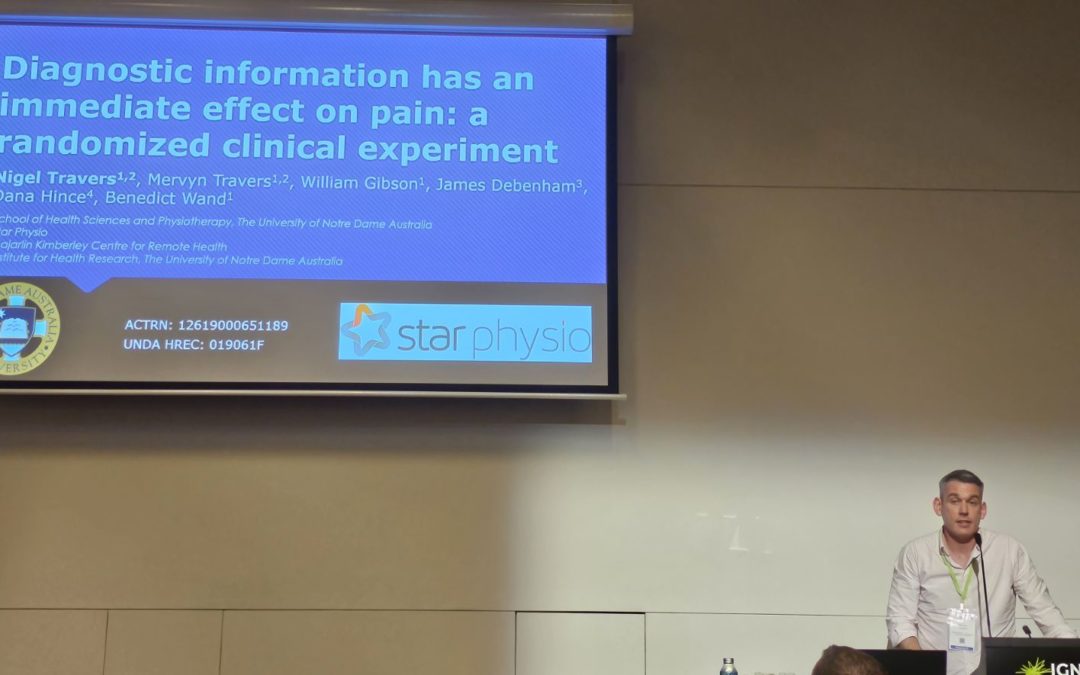
Pain Education
Star Physio Expert Education Educating the nation through pain research. Star Physiotherapists James Lewin, Dr Kevin Wernli (PhD), Dr Merv Travers (PhD) and Damian Oldmeadow have recently returned from the Australian Physiotherapy Association Conference in Brisbane....

Munda Biddi Trip
Munda Biddi - The Trip. Donnybrook (well Kirup) to Albany in 9 days with a mixture of relatively short days and warm showers to tough days and cold water tank rinses was the Munda Biddi journey for Star Physio's Damian Oldmeadow in May this year. If you are...

Munda Biddi Bikepacking
Munda Biddi Bikepacking Musings! Earlier this year, Star Physio's Principal Physiotherapist and Bikefitter, Damian Oldmeadow, enjoyed 9 days of near perfect weather bikepacking on the Munda Biddi trail. Starting near Donnybrook and ending in Albany the trip totalled...
